Mechanical workshop management
A B2B2C ecosystem that transforms mechanical workshops with an advanced CRM, dynamic quote generation and Strava integration to create the bicycle's "Digital Twin".
- Cloud
- 100%
- Time saved
- -40%
- Customer loyalty
- +25%
- Professionals
- 42
The starting point
The bike-maintenance industry is fragmented, processes are manual and asynchronous. The customer goes to the mechanic only once the component has already broken, and the workshop doesn't always have fine tracking of the work and the replacements carried out previously.
On top of this, the communication channel between cyclist and workshop changes and is not always the same.
- Frontend
- 4 out of 5
- Backend
- 5 out of 5
- DevOps
- 5 out of 5
- UX/UI
- 4 out of 5
- Security
- 4 out of 5
The problem we found
The problem was the lack of a system designed for the real dynamics of the cycling world: with the need for a direct and instant line between workshop and cyclists, the need for a detailed history of the operations performed and, above all, the possibility of moving from simple repair to true preventive maintenance.
The stack
 React
React Node.js
- Docker
- AWS
 MUI
MUI PostgreSQL
 TypeORM
How we worked.
- 01
Enable Predictive maintenance
Collect objective training data (distances covered, usage times, ..) to precisely calculate the breakage thresholds of the various components before the possible failure.
- 02
Build an immediate CRM
Reshape the workflow in order to digitalize quotes, work orders, registry cards, garages and bike maintenance.
- 03
Connect the ecosystem
Connect not only apps like Strava (a leader in GPS tracking of sports activities) but also the user to the workshop, making them aware of the work done and to be done.
- 04
Architectural resilience
Structure the cloud on ECS to asynchronously govern webhooks and requests coming from different clusters, mitigating the risk of service downtime.
Features under review
Focus on features and solutions
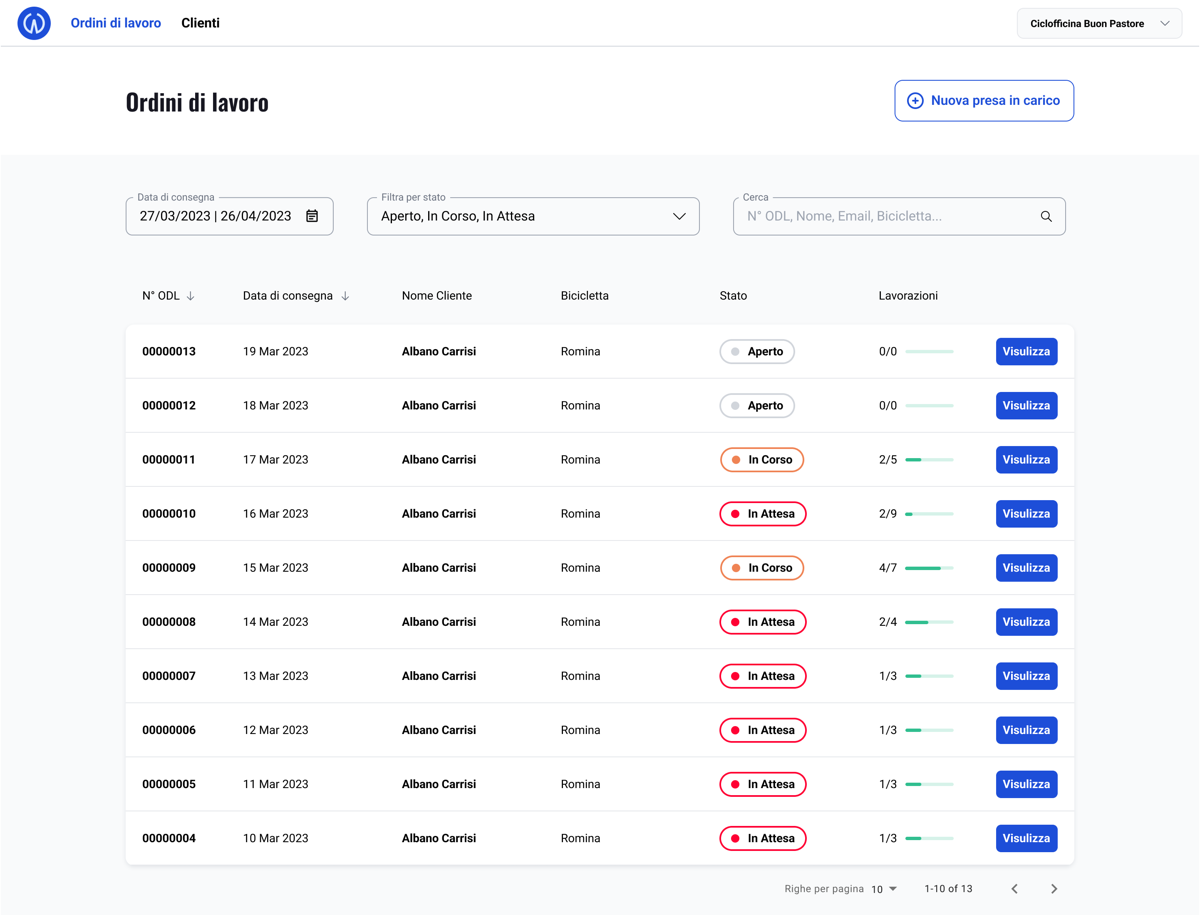
Operational Dashboard
Clear and direct lists that, thanks to multi-filters, project the global status of all the jobs in progress, helping to supervise daily activities and upcoming deadlines. Taking charge becomes a "simple" list from which to draw all the information and on which to note all the problems or communications to report.
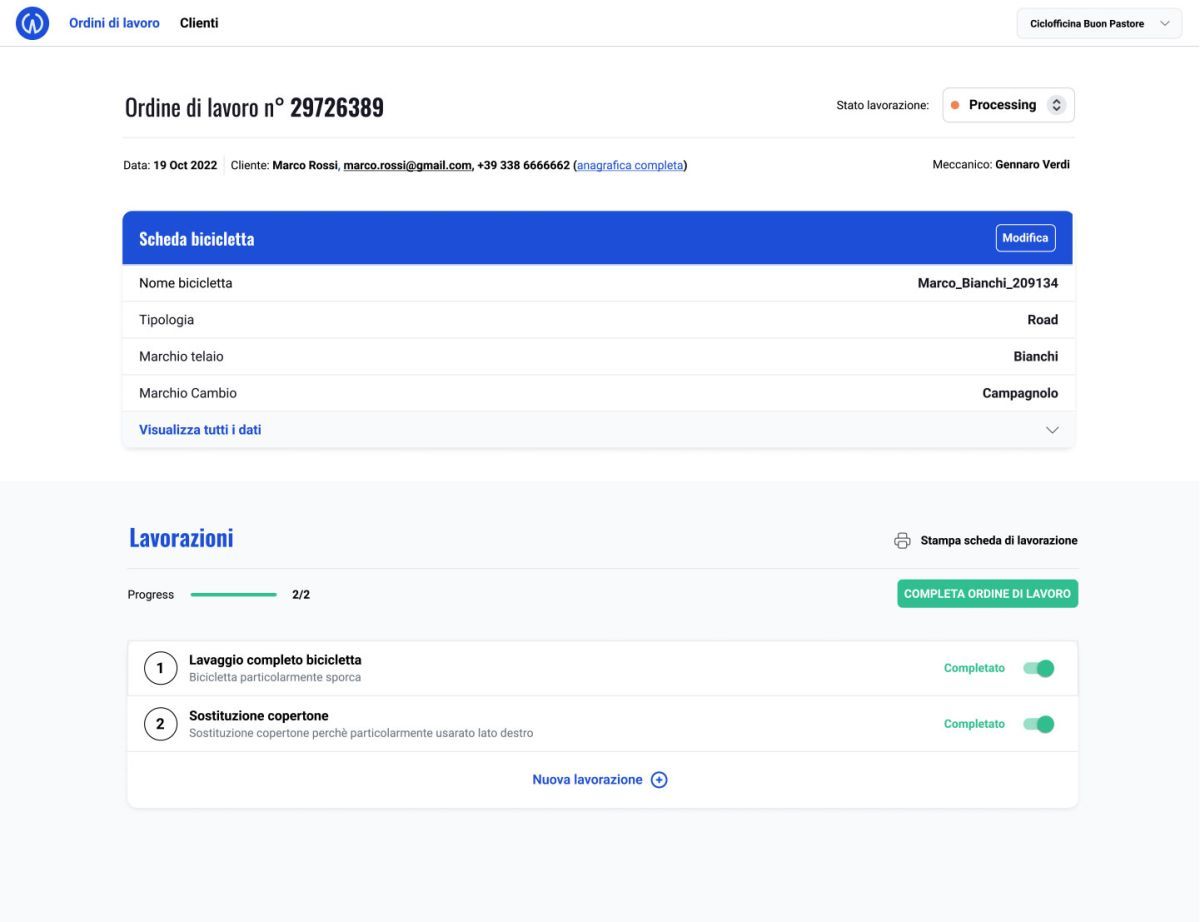
Bench workflow
To guarantee quality for the customer, each bicycle has its own logical breakdown for the "Work status", splitting complex macro-tasks into mandatory progressive checklists ("Cable fitting", "Wheel truing", "Basic wash"). By checking off a process, the task progress bar triggers events that keep the reception desk updated to foster horizontal internal communication.
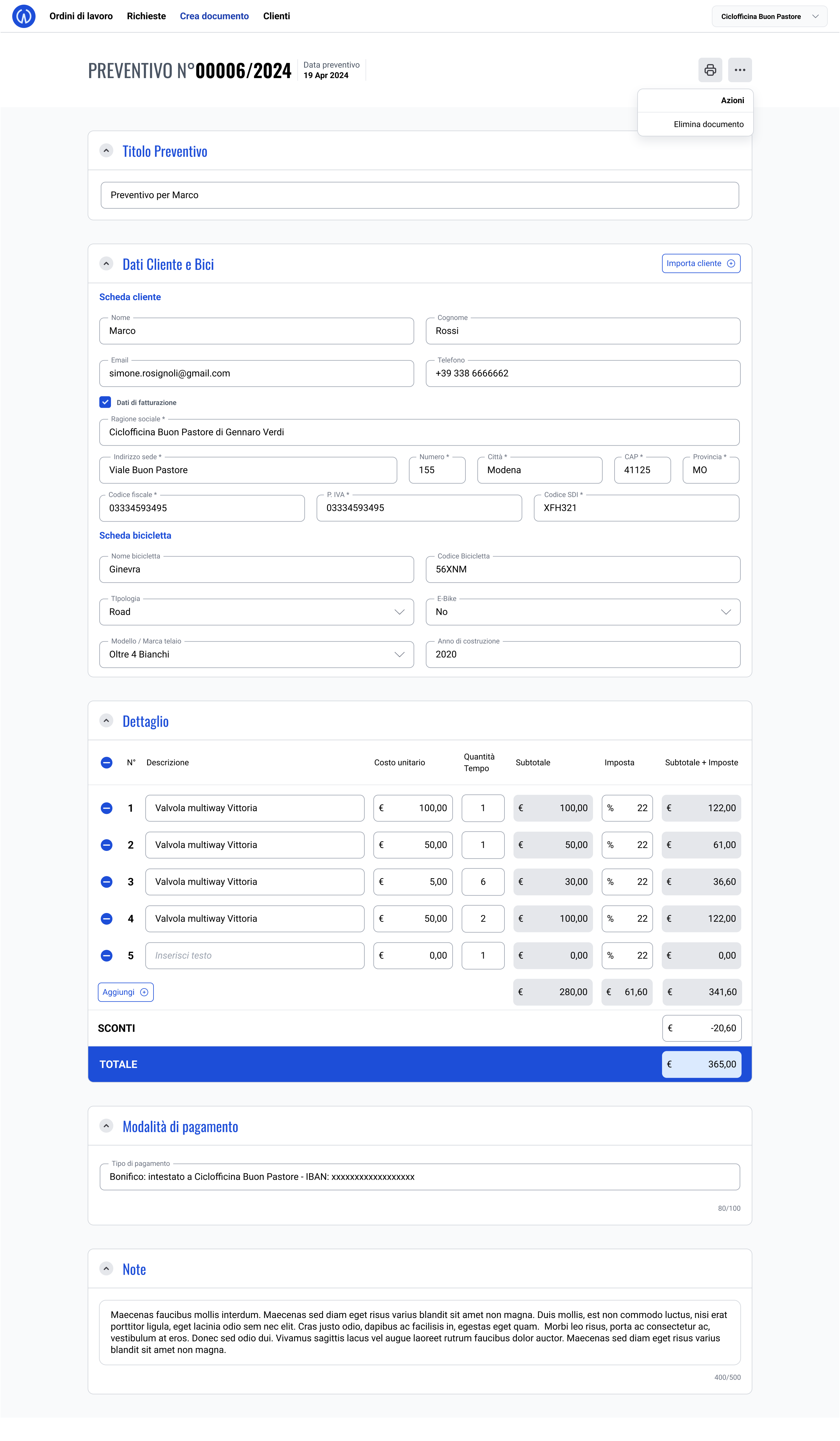
Assisted quoting
Separate the mechanical operations from the formal sales. The operator accesses a linear User Interface and composes the offer in a split-second, integrating hourly costs and itemized parts ("Carbon rims", "Multiway replacement", "Discount apply"). The cloud engine silently sends the data in JSON to a headless browser instance (Puppeteer) that builds and seals the offers live in PDF, returning them linked to the customers. Operations that took hours, solved in milliseconds.
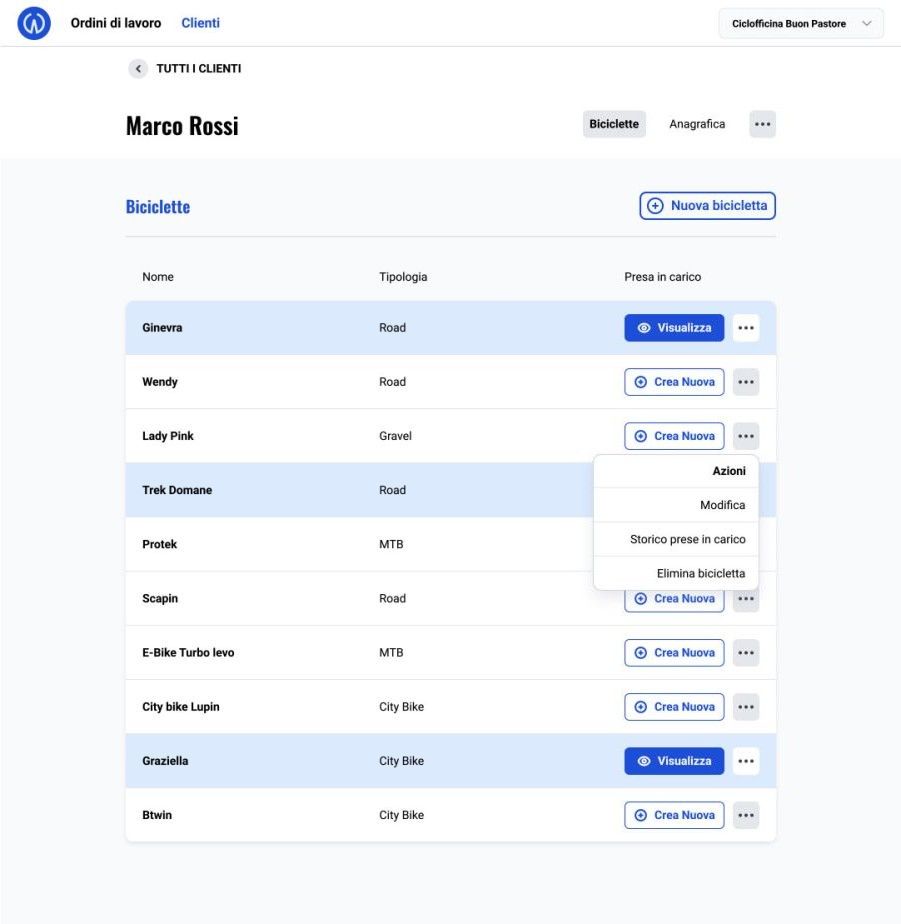
Digital Twin of the bike fleet
The customer registry expands its horizon by introducing the "Digital Garages". By precisely identifying frame types and matching the serial number for Road, Gravel, MTB or E-Bike, the workshop has, in retrospect, the exact temporal picture of the wear. Thanks to the Strava APIs, where consented, the server reads the exact usage, estimating the structural decay of the bearings and automatically prompting the customer by email for a preventive check, offering the optimal appointment to avert on-road damage. Flexibility and upselling driven by technical data.
Want to speed up operations?
If you're planning to increase your logistics and workshop operations, let's talk. We build secure, modular systems, with an API First logic, that fully support the load without hindering usability.
What is the real impact of Cloud-Native architecture for workshops?
A containerized SaaS approach allows for a flexible architecture that is, above all, tunable for cost and performance. Moreover, it allows distributed accessibility even outside the workshop. Our systems all have a superior level of security, for example through time-limited token management, MFA and httpOnly.
Why integrate external systems and services?
Depending on the system, integrating external services allows a substantial improvement in product adoption and loyalty. During design and implementation, however, you must follow Best Practices, namely not building products around the services to be integrated but making them "replaceable" when needed. This way you create a platform-centric system, changeable on demand and not dependent on or "locked" to the various vertical features.
How do you design management software in a mechanical context?
The mechanical context demands several rules to turn a nice user interface into an efficient and effective one. For example, beyond the devices in the workshop (screen and power), you have to pay attention to the network topology in order to understand how the nodes (PCs, tablets, other devices, ..) are connected to each other and design the API calls, their payload, and add advanced mechanisms in case of any problems (slow network, going through external connections, with high packet loss, ..).
Can the system later evolve with other company tools?
The architecture is based on RESTful APIs and on the OSS backend framework (Volcanic Minds Backend), so integration with other existing services (Data & Business intelligence, billing tools, ..) is supported. Moreover, being developed with an API-first approach, it's possible to let external services or products (legacy or third-party) connect to the entire ecosystem.
How does the system adapt to higher usage loads?
The containerized SaaS approach allows resource scalability both as requests grow and as the working group grows (employees, externals, other companies, ...). Moreover, where needed, it's possible to create or add micro-services for operations with high time and resource impact. This is the beauty of having a system that is potentially infinitely scalable.